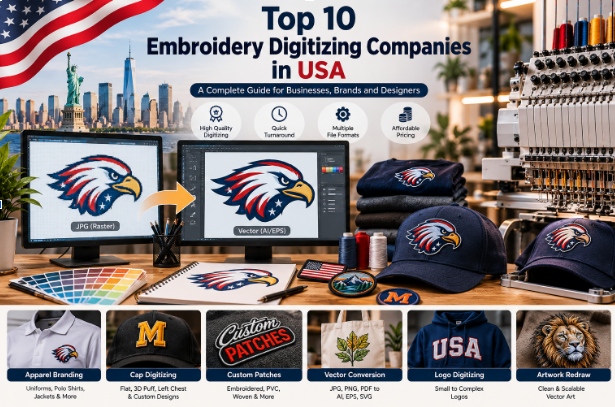
The best embroidery digitizing company for your project is one that creates machine-compatible stitch files, understands fabric behavior, offers clear revision support, and prepares designs for their intended application. For USA businesses, factors such as production reliability, logo accuracy, turnaround time, and vector artwork support are often more important than choosing the lowest advertised price.
Embroidery is an important part of branding for American businesses, sports teams, fashion labels, promotional product companies, and uniform suppliers. A carefully embroidered logo can make ordinary clothing look professional, recognizable, and consistent with a company's identity.
However, high-quality embroidery begins long before the machine starts stitching.
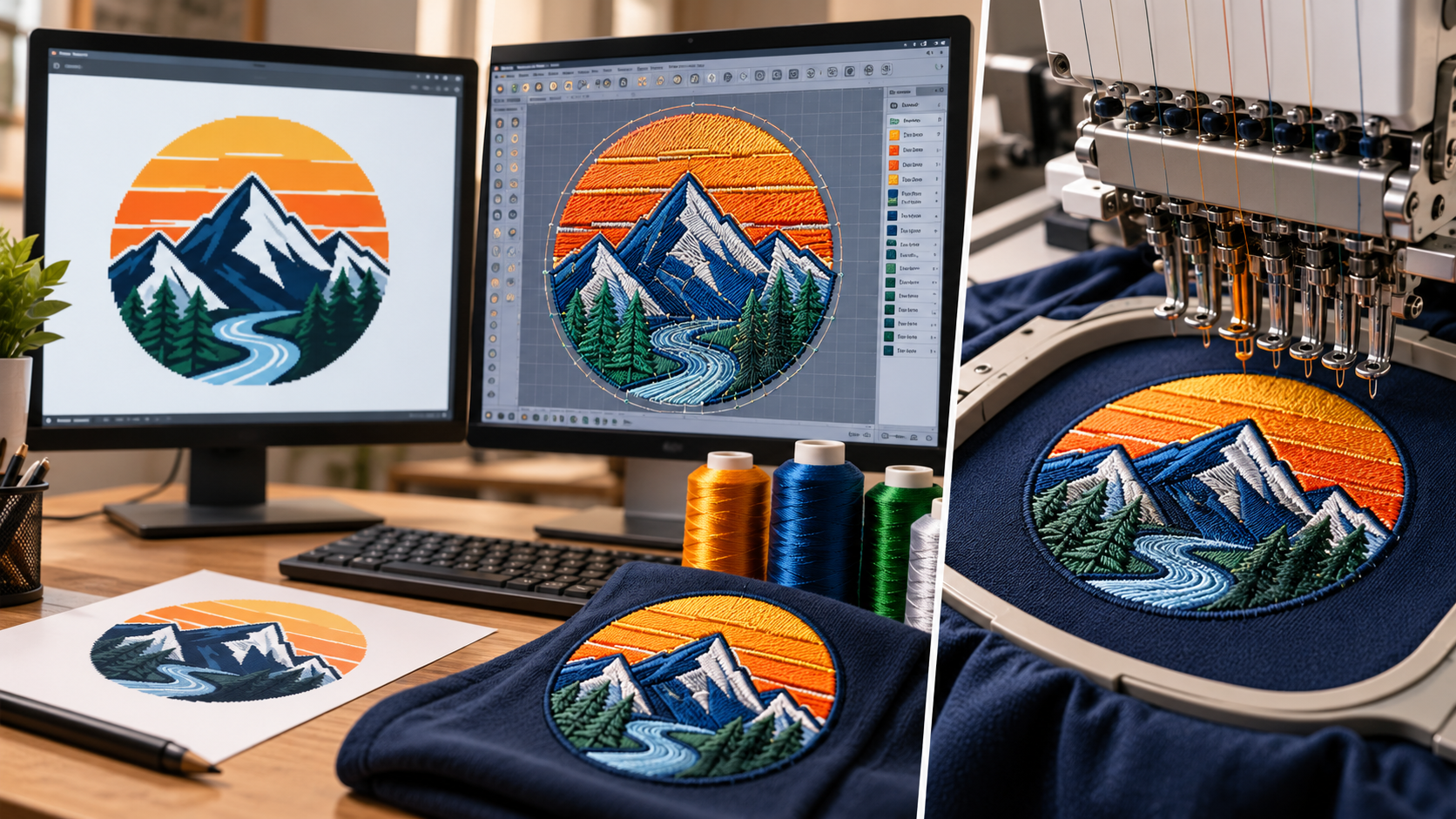
Behind every embroidered logo is a digital file containing instructions for needle movement, stitch direction, thread changes, and design sequencing. The process of creating these instructions is known as embroidery digitizing.
Choosing a suitable embroidery digitizing company can make the difference between a clean, durable design and one that suffers from thread breaks, puckering, distorted lettering, or uneven coverage.
Businesses also frequently need vector conversion services to transform low-resolution logos into clean, scalable artwork. Although vector conversion and embroidery digitizing are different processes, they often support the same branding and production projects.
This guide explores ten embroidery digitizing providers serving the US market, explains the technical factors that influence quality, and discusses how vector artwork contributes to successful embroidery production.
The companies are presented as options to research rather than a statistically verified ranking. There is no independent industry-wide testing that establishes a definitive top ten.
Embroidery digitizing services convert artwork into stitch instructions that computerized embroidery machines can interpret.
A JPG, PNG, or PDF logo may display perfectly on a computer screen, but it does not automatically contain the information needed for machine embroidery.
A digitizer must determine how each design element should be stitched.
This includes selecting running, satin, or fill stitches, adjusting density, creating underlay, compensating for fabric movement, and organizing the stitching sequence.
For example, a logo intended for a lightweight polo shirt requires different considerations from a large design embroidered onto a denim jacket.
The digitizer must account for the material, design dimensions, and intended placement rather than simply reproducing the image's visible appearance.
Professional digitizing aims to create files that are visually accurate, efficient to stitch, and appropriate for the final product.
The following providers represent different service models, including custom digitizing, commercial production support, logo embroidery, and specialized patch preparation.
They should not be interpreted as a verified ranking by quality, revenue, customer satisfaction, or market share. Service availability, prices, and turnaround times should be confirmed directly before ordering.
Migdigitizing offers artwork preparation services for businesses, embroidery shops, apparel decorators, and independent designers.
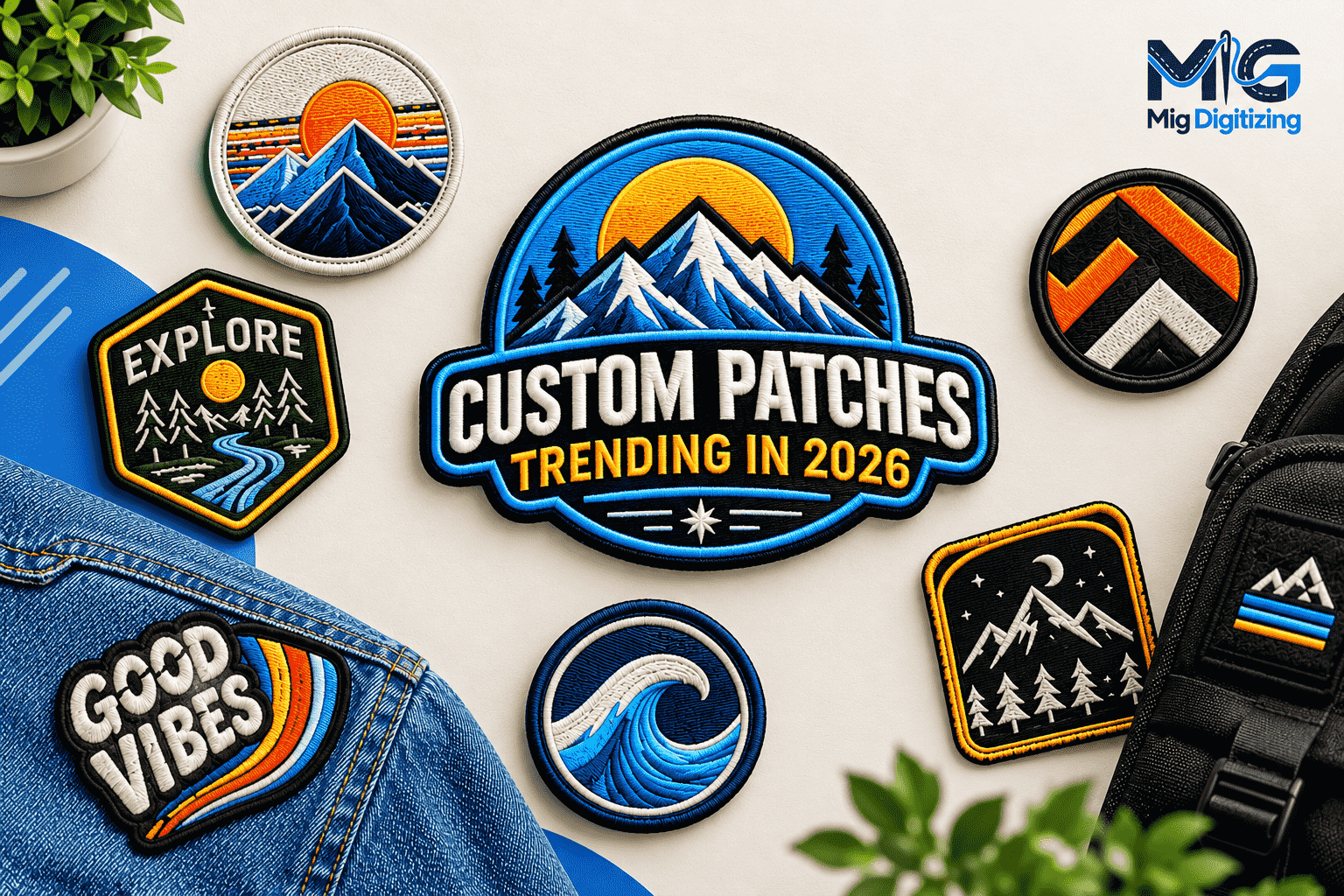
Its services include embroidery digitizing, vector conversion, and custom patches, making it a relevant option for customers who need more than a single type of artwork preparation.
According to the company's published business information, it has operated since 2009 and offers embroidery digitizing starting at $8 per design. Actual pricing depends on the artwork and order requirements.
Its service categories include logo digitizing, cap embroidery, left-chest designs, jacket-back embroidery, appliqué, and 3D puff embroidery.
Why consider Migdigitizing?
Businesses frequently need to prepare the same logo for different products. A company may require an embroidery file for uniforms, vector artwork for printed merchandise, and custom patches for employee jackets.
Working with a provider offering these related services can simplify artwork coordination.
However, each production method requires separate technical preparation. A vector file should not be confused with an embroidery stitch file, and a patch design may require additional manufacturing specifications.
Migdigitizing is worth considering for customers seeking a combined artwork-service workflow, particularly when multiple branding applications are involved.
Emb-digit offers embroidery digitizing services for commercial applications, including company logos, caps, jackets, and apparel branding.
Its published service categories include left-chest digitizing, appliqué, 3D puff embroidery, and custom patch-related work.
For commercial embroidery shops, one important consideration is whether the digitizing provider understands production requirements rather than concentrating only on the appearance of the artwork.
For example, a large jacket-back design needs balanced stitch coverage and careful sequencing to reduce unnecessary machine movement.
Digit-IT is an option to evaluate for businesses handling varied apparel decoration projects.
Quality Punch is associated with embroidery digitizing and related artwork preparation.
Commercial decorators often require consistent digital files for repeat production.
For example, a uniform supplier may need the same corporate logo embroidered across several garment types and sizes.
Consistency depends on accurate design specifications, appropriate file organization, and communication about changes in fabric or placement.
When considering a provider for commercial work, confirm its ability to manage repeat orders, file revisions, and production-specific requirements.
Absolute Digitizing is a provider to consider for logo-focused embroidery projects.
Company logos can be deceptively challenging to digitize.
A design may contain narrow lettering, small registered trademark symbols, thin borders, or multiple overlapping shapes.
These details require careful planning because thread cannot reproduce every pixel of the original artwork.
Businesses comparing logo digitizing providers should evaluate the clarity of lettering, alignment of outlines, and performance of designs at their intended size.
ZDigitizing is another provider associated with embroidery digitizing and artwork conversion services.
Small embroidery businesses often require machine-ready logo files without investing substantial time in learning advanced digitizing software.
A provider serving this market should be able to work with common artwork formats, explain design limitations, and deliver files compatible with the customer's equipment.
When evaluating ZDigitizing, customers should request relevant samples and confirm which revisions and output formats are included.
Eagle Digitizing is another option for customers comparing embroidery digitizing providers.
Different embroidery applications require different approaches.
Cap designs, for example, must account for curved surfaces and restricted embroidery areas. Large jacket designs require attention to stitch distribution and fabric stability.
A provider's experience with a particular product category may be more valuable than general claims about quality.
Customers should request examples relevant to their intended garment or material.
Sew And Grew appears in industry provider comparisons as an option associated with boutique embroidery applications.
Fashion-oriented embroidery can involve delicate fabrics, decorative lettering, and designs intended to complement garment construction.
Lightweight materials may require careful density management and stabilization to avoid excessive distortion.
When evaluating services for boutique apparel, consider whether the provider understands the difference between decorative appearance and practical stitch performance.
The Hem Stitching is another provider mentioned in embroidery service comparisons.
Complex artwork may involve many overlapping elements, multiple thread colors, and intricate outlines.
A detailed design can require more planning than a simple company wordmark, even when both occupy similar dimensions.
For complex projects, customers should ask how the provider handles small details, stitch sequencing, and design simplification.
The ability to explain technical limitations is an important indicator of a thoughtful digitizing process.
My Patches is associated with custom patch applications.
Embroidered patches differ from direct garment embroidery because they are often produced separately and attached to a finished product.
Patch preparation may involve borders, background coverage, backing materials, and edge-finishing requirements.
Some designs also need to accommodate merrowed or heat-cut borders.
Customers should confirm whether the service includes digital artwork preparation, physical patch manufacturing, or both.
These are different deliverables and should be clearly identified in the order.
Stitch America is another business to research when comparing embroidery-related services and production workflows.
For businesses purchasing embroidered products, production capability and digitizing capability should be evaluated separately.
A company that produces embroidered garments may handle digitizing internally, outsource it, or use files supplied by customers.
Before ordering, confirm whether custom digitizing is included, what machine formats are accepted, and whether sample approval is available.
| Company | Area to Investigate |
|---|---|
| Migdigitizing | Digitizing, vector artwork, and custom patches |
| Emb-Digit | Commercial embroidery and apparel applications |
| Emb Punch | Commercial and repeat-order workflows |
| ZDigitizing | Logo and general embroidery digitizing |
| Absolute Digitizing | Business logo preparation |
| Eagle Digitizing | Multiple embroidery applications |
| Sew And Grew | Boutique and decorative embroidery |
| The Hem Stitching | Detailed artwork preparation |
| My Patches | Custom patch-related work |
| Stitch America | Embroidery production and file requirements |
These descriptions are intended to guide further evaluation, not to establish comparative performance or verified specialization rankings.
Selecting a digitizing provider should begin with understanding your actual production requirements.
A high-quality embroidery file should produce clean shapes, readable lettering, appropriate thread coverage, and smooth stitching.
A visually attractive computer preview is not sufficient evidence of production quality.
Whenever possible, review photographs of actual embroidery samples.
Different embroidery machines support different file formats.
Common formats include DST, PES, JEF, EXP, VP3, and HUS.
The correct format depends on the machine model and controller.
Fast delivery can be valuable, particularly for businesses managing urgent customer orders.
However, turnaround should be evaluated alongside accuracy and revision support.
Clarify whether the delivery estimate includes artwork review, digitizing, corrections, and testing.
A design intended for fleece may require different settings from one intended for lightweight polyester.
Ask whether the provider considers garment type, stretch, finished dimensions, and placement before digitizing.
A low initial price may not include additional sizes, editable source files, major revisions, or specialized production preparation.
Compare quotations based on equivalent deliverables rather than advertised starting prices alone.
Vector conversion is an important supporting service for businesses working with logos, branded apparel, printing, and promotional merchandise.
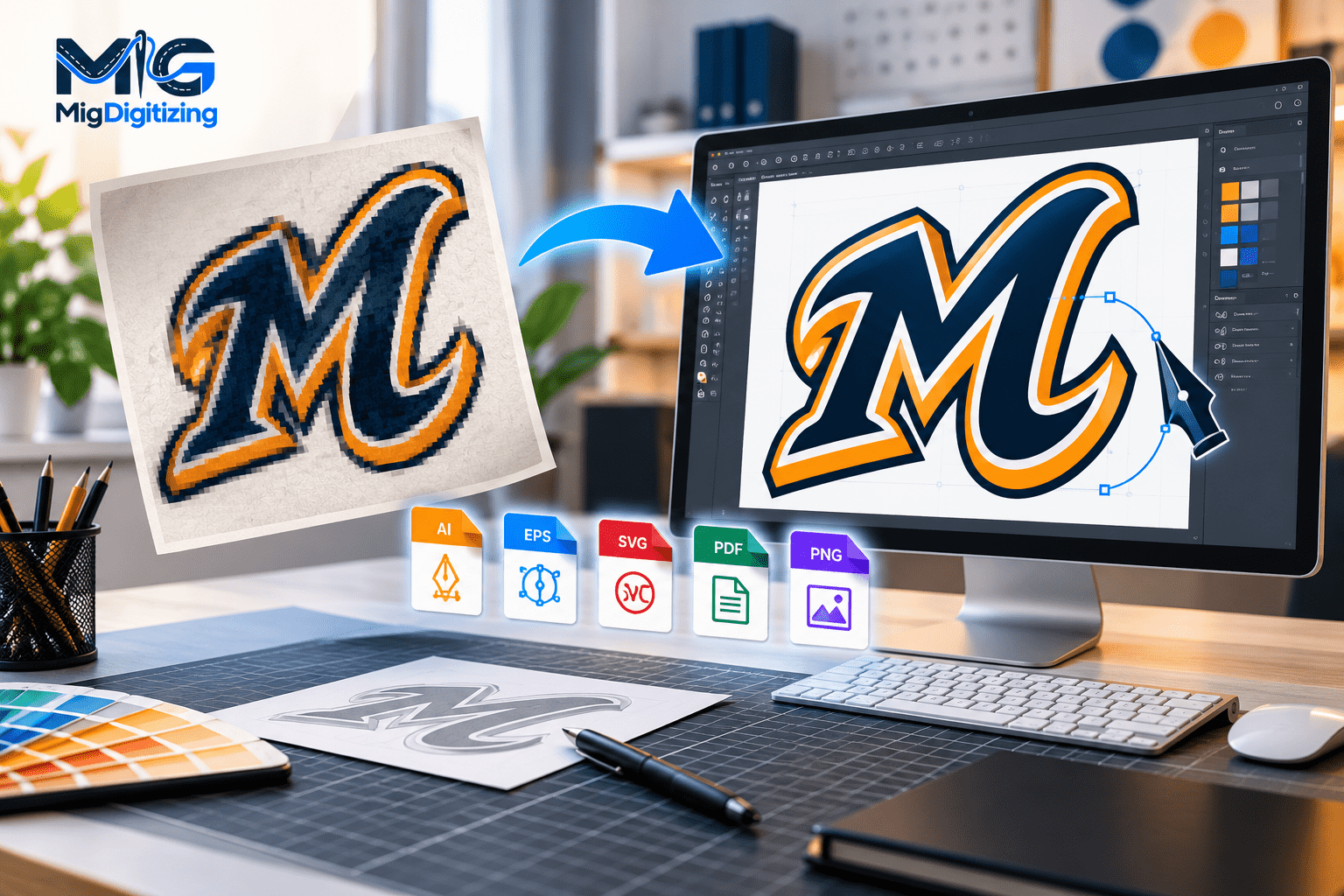
A customer may supply a small JPG logo that looks acceptable on a website but becomes blurry when enlarged.
Vector conversion reconstructs that image using mathematical paths, curves, and shapes rather than pixels.
The resulting artwork can be resized while maintaining smooth geometric edges.
However, vector conversion and embroidery digitizing are not interchangeable.
| Feature | Raster Image | Vector Artwork |
|---|---|---|
| Structure | Pixels | Paths and shapes |
| Typical Formats | JPG, PNG, TIFF | AI, SVG, EPS |
| Enlarging | May become pixelated | Maintains smooth geometry |
| Editing | Pixel-based | Object-based |
| Common Uses | Photos, digital images | Logos, printing, cutting |
| Embroidery Ready | No | Requires digitizing |
A vector logo can provide a clean reference for embroidery digitizing, but it does not automatically contain machine stitch instructions.
The process typically begins with reviewing the original artwork.
A designer identifies important shapes, lettering, colors, and visual details.
Next, the artwork is reconstructed using manual tracing, automatic tracing, or a combination of both.
The designer then refines curves, removes unnecessary anchor points, corrects distorted shapes, and checks typography.
Finally, the artwork is exported in suitable formats such as AI, SVG, EPS, or PDF.
A professional vector file should contain genuinely editable paths where required. Simply embedding a JPG inside a PDF does not make the image vector-based.
Consider a small construction company in Texas preparing new employee uniforms.
The company has an old JPG logo that must appear on embroidered polo shirts, printed safety vests, and promotional banners.
The original image may be sufficient as a visual reference, but each application has different technical requirements.
First, the logo can be reconstructed as scalable vector artwork for printing and future design adjustments.
Next, the artwork can be digitized into machine embroidery instructions for the polo shirts.
The embroidery file must account for the finished logo size, fabric properties, stitch density, underlay, and lettering.
Finally, the company can retain separate master files for printing and embroidery.
This approach supports consistent branding while recognizing that different production methods require different files.
For businesses managing several decoration methods, coordinating vector conversion and embroidery digitizing through one artwork provider may reduce unnecessary communication and version confusion.
Choosing the correct embroidery format is essential for successful machine operation.
| Format | Common Machine Association |
|---|---|
| DST | Tajima and many commercial machines |
| PES | Brother and Baby Lock |
| JEF | Janome |
| EXP | Melco and compatible commercial systems |
| VP3 | Husqvarna Viking and Pfaff |
| HUS | Certain older Husqvarna Viking machines |
These associations are general. Compatibility should always be checked against the specific machine model.
A machine file may not retain all the editable information available in the digitizer's original project.
For this reason, maintaining both an editable source file and the required machine export can make future changes easier.
Understanding the fundamentals of embroidery helps customers evaluate digitizing work more effectively.
Density determines how closely stitches are positioned.
Excessive density can create stiffness, puckering, and unnecessary thread buildup.
Insufficient density may leave visible fabric gaps.
The appropriate setting depends on the fabric, thread, stitch type, and design structure.
Underlay provides a foundation beneath the visible embroidery.
It can help stabilize the material, support top stitching, and improve the appearance of certain shapes.
Different objects may require different underlay structures.
Embroidery thread applies tension to fabric during stitching.
This can cause shapes to become narrower or move slightly from their intended positions.
Pull compensation helps account for these changes.
The order in which objects are embroidered affects efficiency and registration.
A carefully planned sequence can reduce unnecessary trims and help maintain alignment.
However, reducing color changes should not compromise the finished design.
A digital simulation cannot fully reproduce the physical interaction between thread, needle, stabilizer, and fabric.
Testing on representative material remains one of the most useful ways to evaluate an embroidery file.
Even experienced businesses occasionally encounter avoidable problems.
One common mistake is submitting artwork without specifying the final embroidery size.
Small lettering that works on a jacket back may become unreadable when reduced for a cap.
Another mistake is assuming that every JPG can be converted without design adjustments.
Complex gradients, fine outlines, and tiny details may need simplification.
Some customers also request the wrong machine format or assume that an embroidery file can be enlarged indefinitely.
A design optimized for a three-inch logo may require redigitizing before being used at a substantially different size.
Finally, skipping test stitching can allow technical problems to reach full production.
Providing accurate requirements and reviewing the finished sample can reduce these risks.
A clear order brief makes it easier for the digitizer to prepare an appropriate file.
Include the original artwork, desired dimensions, garment type, embroidery placement, machine format, and preferred thread colors.
If the design includes lettering, provide the exact spelling.
For specialized techniques such as 3D puff, appliqué, or cap embroidery, mention the requirement before work begins.
If the project also needs vector artwork, identify the intended printing or production application and the required output formats.
When deadlines matter, specify the date and time zone.
For larger orders, clarify whether the deadline applies to digital file delivery, sample approval, or completed physical products.
There is no universally best provider for every project. The right choice depends on artwork complexity, fabric type, required file formats, budget, revision support, and production deadlines. Review relevant stitch samples and confirm deliverables before ordering.
Embroidery digitizing creates machine-readable stitch instructions. Vector conversion creates scalable artwork using editable paths. Vector artwork can support embroidery preparation, but it is not automatically an embroidery file.
Yes. JPG artwork can be digitized into embroidery formats such as DST or PES using suitable software. Simply renaming the file extension does not create valid stitch instructions.
Prices vary according to design complexity, size, provider, revisions, and special requirements. Some services advertise low starting prices, but customers should confirm the complete cost for their specific artwork.
Manual digitizing provides greater control over stitch placement, direction, density, and sequencing. Automatic tools can assist with simple artwork, but their results should still be reviewed and adjusted when necessary.
Thread behaves differently from digital pixels. Fabric movement, stitch direction, density, and physical size limitations can affect the final appearance. Some artwork elements may also require simplification.
Not necessarily. Clean raster artwork can often be digitized directly. Vector conversion becomes useful when the original image needs reconstruction or when scalable artwork is also required for printing and branding.
Sometimes, but not always. Caps and flat garments have different construction characteristics. A design may need adjustments to stitch sequencing, density, underlay, or dimensions for reliable results.
Provide clear artwork and production specifications, select the correct machine format, review design proofs, and test new files on representative fabric before beginning large orders.
Finding a suitable embroidery digitizing company involves more than selecting a familiar business name or comparing starting prices.
Quality digitizing requires technical knowledge, accurate artwork interpretation, appropriate stitch planning, and an understanding of real production conditions.
For USA businesses managing uniforms, promotional merchandise, sports apparel, or custom patches, reliable artwork preparation can support consistent branding and reduce avoidable production problems.
Vector conversion adds another useful capability by creating scalable artwork for printing, signage, packaging, and other applications.
Migdigitizing brings these related services together through embroidery digitizing, vector artwork preparation, and custom patch solutions.
Whether working with Migdigitizing or another provider, customers should prioritize clear communication, suitable file formats, realistic turnaround expectations, and quality checks before production.
The objective is not simply to receive a digital file. It is to obtain artwork that performs correctly for its intended purpose
Oct 28 , 2026 at 03:29:32
Oct 26 , 2026 at 11:50:04
Oct 23 , 2026 at 09:07:12