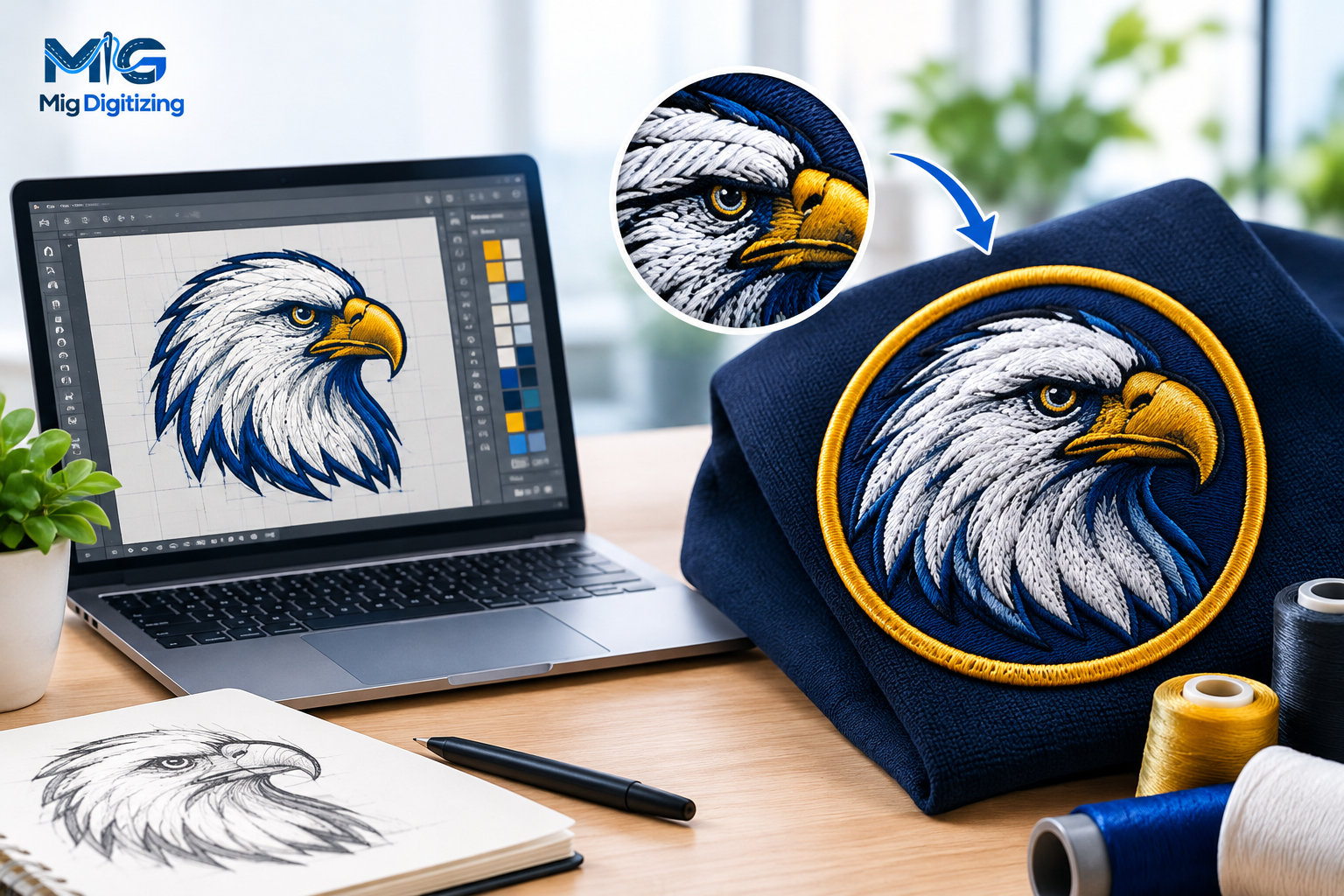
A wonderful embroidered design is built long before the embroidery machine starts to stitch. So, what makes the difference between an ordinary embroidered logo and a premium-quality finished product? Only expert digitizing!
Many firms don’t realise how complicated embroidery digitizing is. A basic logo may require careful preparation of stitch direction, density, underlay, thread sequence and fabric behaviour before it can be a neat embroidered design.
For firms who want great embroidered results but do not want to invest in pricey software, equipment and specialised staff, outsourcing embroidery digitizing services can be a sensible alternative.
If you are a clothing brand, promo product supplier, corporate uniform provider, startup, or embroidery business, working with an experienced partner like MIG Digitizing allows you to make your artwork into high-quality embroidery solutions while focusing on growing your business.
When you outsource embroidery digitizing, you’re working with skilled digitizers who take your artwork, logo, or design idea and turn it into a machine-ready embroidery file.
Embroidery digitizing is not just a simple image conversion since it involves some technical knowledge about the behaviour of stitches on different fabrics.
According to a professional digitizer:
Complexity of design
Type of fabric
Embroidery dimension
Stitch width
Direction of thread
Structure of underlay
Colour order
Final product specifications
The aim is not just to produce a file that an embroidery machine can read. The objective is to achieve a design that yields a clean, durable, and aesthetically pleasing embroidered product.
For example, the same logo may require multiple digitizing methods depending on:
· Polo shirts
· Caps.
· Jackets.
· Bags.
· Clothing
· Patches embroidered
· Giveaways
That’s why professional outsourcing pays well. The experienced digitizers know how the digital artwork relates to the actual embroidery outcome.
The embroidery business is quite competitive. Customers want good-looking designs, quick turnaround, and consistent quality.
But that’s a lot to deal with inside.
Businesses frequently run into problems with:
Locating experienced digitizers
Buying pricey embroidery software
Training for staff
Handling growing order volumes
Quality consistency maintenance
Working intricate embroidery patterns
Outsourcing means that you can get the professional knowledge without having to develop a complete embroidery department from the beginning.
Businesses can spend their efforts focusing on: Not tackling technical embroidery problems.
· Customer acquisition
· Design and development
· Sales
· Branding
· Manufacturing Management
One of the greatest benefits of outsourcing is that you have access to talented individuals who know about embroidery manufacturing.
Experienced digitizers understand that effective embroidery is more than just translating an image into stitches.
They know:
How various textiles respond
The effect of stitch density on the look
How lettering stays legible
Designs for caps or curved surfaces.
How to cut needless thread use
Hiring and training an in-house digitizer takes a lot of time and cost. By outsourcing, companies get instant access to seasoned specialists.
This is very helpful for:
New embroidery companies
Brand fashion
Small businesses
Business entry into the custom embroidery market
Instead of spending months building technical proficiency, firms may rely on people who already know the process.
Starting an internal embroidery digitizing department is not simply hiring an employee.
Businesses may require:
Software for professional digitizing
Computer
Training of employees
Wages
Software updates
Quality testing procedures
These costs can be a heavy burden for small and expanding organisations.
Companies only pay for the services they need through outsourcing.
This converts the digitisation from a fixed operating expense to a flexible business expense.
For instance:
Sometimes a clothing business that needs embroidered logos doesn’t need a full-time digitizer.
A promotional company that takes orders on a seasonal basis may not seek permanent workers.
Outsourcing can allow these organisations to take advantage of professional services as and when required.
Many competing publications mention cost savings as a significant benefit of outsourcing. For developing companies, eliminating costs of software, labour and training is one of the biggest benefits.
A design that has been poorly digitised can be detrimental to the result.
Poor quality digitizing can lead to the following problems:
Seams uneven
Thread breaks.
Bad Letter Visible
Too tight thread
Pulled fabrics
Distorted logos.
Poor design appearance
The goal of professional embroidery digitizing is to provide files that are ready to go to actual production.
Digitizers with experience plan carefully:
Stitching Direction
Stitch direction is important for smoother texturing and better visual flow.
Emphasise
A good underlay will prevent distortion and keep the design stable.
Thread Counts
The design is well balanced in density, so the cloth looks intricate without being rigid.
Compensation Pull
This helps to keep the shapes accurate as the fabric naturally moves as you are stitching.
The outcome is professional-looking embroidery that accurately displays your business.
Time is one of the most valuable resources of any organisation.
Many organisations waste significant hours trying to prepare artwork, repair embroidery difficulties, or deal with intricate files.
Companies can use the time they save by outsourcing digitizing to focus on growth-driving activities.
Instead of dealing with the technical embroidery set-up, you may focus on:
Customer Acquisition (New)
Manufacturing products
Marketing Excellence
Order Processing
Building customer relations
Growing brands have potential for growth by reducing time.
Order volumes can change rapidly.
A business may receive:
Uniform company contracts
Sports team sales
Requests for festival merchandise
Advertising campaigns.
Bulk clothing projects
Busy periods can leave internal teams overwhelmed with tasks.
Outsourcing is extra support that is needed when demand increases.
You can take on more projects without instantly adding staff or growing your infrastructure.
This flexibility is especially beneficial to companies with seasonal demand.
Not every embroidered project is a breeze.
Some designs demand more advanced knowledge, such as:
Detailed logos
Tiny lettering
Puff embroidery 3D
Caps Embroidery
Patches, embroidered
World of jacket-back designs
Embroidery has its physical limits; thus, intricate artwork has to be well thought out.
A competent digitizer has the skill to change designs and keep the original appearance.
They have a choice:
What details need to be simplified
Changing the direction of the stitches
How to read it more easily
This prevents unsatisfactory results when production is underway.
In the embroidery industry, delays in the digitizing stage might disrupt the whole production timeline. Even with the embroidery machines ready, you can’t start production if the design file is not prepared correctly.
Businesses may prevent these delays by using professional embroidery digitizing services that can provide skilled support to get designs ready quickly.
This is particularly handy for handling:
Customer rush orders
Corporate clothing projects
Event Merchandising
Seasonal promotions
Bulk embroidery requirements
A professional partner for digitizing already has the experience, workflow, and instruments to cope with diverse design needs efficiently. Companies can go to production quicker instead of spending time fixing artwork or learning new software.
But speedier turnaround should never come at the expense of quality. A good digitizer is one who produces production-ready files and has a good sense of speed and stitch planning.
Companies that employ embroidery for branding purposes need to be very consistent.
Your company logo should seem professional whether it shows on:
· Polo shirts
Workwear
Hats and
Jackets
Bags
Contests/Giveaways
If you don’t digitise properly, the same design will look different on different fabrics.
An example:
What looks great as a flat cotton T-shirt logo may need some tweaking when embroidered on a structured cap; the curved surface can do things to that embroidery.
Pros know how different products impact embroidered outcomes. They customise designs according to:
Thickness of fabric
Type of product
Embroidery (position)
Stitch must
Machine constraints
This enables firms to retain a consistent logo on all embroidered items.
Modern embroidery is so much more than just logos and lettering.
Increasingly, companies are asking for distinctive embroidery styles that need sophisticated technical understanding.
Professional digitizing partners can assist with:
3D Puff Embroidery
Common uses for:
· Caps.
Hats Hats
Streetwear design
It offers a raised, dimensional look which makes logos pop.
Embroidery - applique
This technique involves adding pieces of cloth to embroidery threads, creating distinctive designs and minimising the amount of stitches.
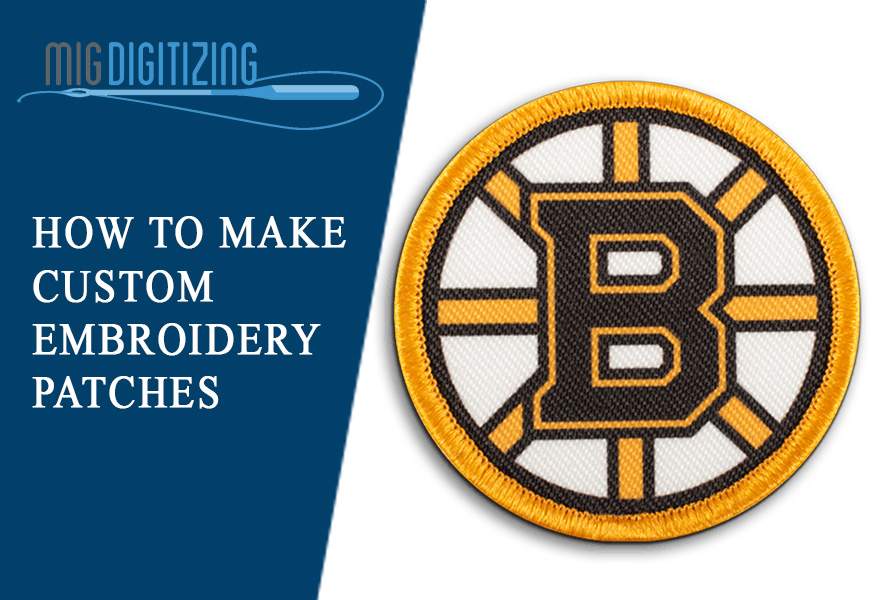
Patches with Embroidery
Patches need precise border, density, and cut considerations to generate tidy results.
Small Lettering
Letters can become illegible if digitizing is done poorly, and tiny text is one of the most difficult stitching operations.
Big Jacket-Back Designs
For larger designs, space your stitches out so you don’t end up with heavy, uncomfortable stitching.
With experts on hand, companies may work on more imaginative initiatives without worrying about technical limits.
You will pay for every embroidered mistake.
A badly constructed file can cause:
Leftover clothes
More thread consumption
Equipment downtime •
Several efforts at manufacture
Late deadlines
By preparing the data according to the actual requirements of embroidery, professional digitizing avoids these dangers.
A good digitizer will think about:
Sewing sequence
Movement of the fabric
Thread tension
Design Equilibrium
Machine compatibility
This increases the efficiency of production and decreases waste.
Even slight gains in accuracy can save companies that produce in high volumes substantially over time.
One of the most common questions firms ask is whether they should construct their own internal digitizing or outsource it.
The answer depends on order volume, production needs, and business size and budget.
Factor.
Digitizing Embroidery Outsourcing
In-House Digitizing
Initial investments
Less than
Read more
Software cost, 1. Introduction
No investment needed
Requires costly software
Professional know-how
Access to professionals immediately
Requires staff training
Scalability
Easy to expand capacity
Limited by staff available
elegant designs
Consultants with wide experience
Depends on employee skill level
Monthly bills (~$1,000)
Variable project expenses
Fixed salary and overheads
For companies with consistent, high-volume digitizing needs, an in-house team could be a good fit.
However, many organisations gain from outsourcing since it delivers professional competence without the cost burden of constructing everything internally.
Outsourcing is not exclusively for major embroidery firms. Businesses of different sizes can benefit from expert support.
Clothing Brands
Fashion firms often demand embroidered logos, labels, and special designs but may not want to manage technical embroidery production themselves.
Outsourcing helps them focus on:
Product design
Marketing
· Sales
Brand growth
Small Businesses
Small businesses typically need embroidered uniforms, promotional materials, or branded stuff.
Instead of investing in embroidery equipment and recruiting specialists, outsourcing offers an easier choice.
Providers of Corporate Uniforms
Suppliers of uniforms for companies that
Dining
Security firms
Make companies
Healthcare organisations
often take big orders for embroidery.
Professional digitizing support ensures consistent quality for thousands of goods.
Product Promotional Companies
If you’re a business that sells branded items, you need reliable embroidery solutions to:
Activities
Advertising campaigns
Corporate Presents
A competent partner for digitizing helps them deliver superior products to their customers.
Embroidery Companies
Even established needlework shops outsource when:
Increased workload
Complex designs come in
Deadlines become difficult
They need professional help
Outsourcing allows them to take on more orders without overburdening their in-house crew.
Choosing the proper embroidery partner is as vital as choosing outsourcing itself.
We at MIG Digitizing are more than just converters of artwork into embroidery files. We help businesses produce professional-grade embroidered products with accurate digitizing and expert embroidery solutions.
The process deals with:
Knowing What You Want in a Design
Every project starts with understanding:
Details of the artwork
Kind of product
Embroidery size wanted
Requirements for placement
Application Final
Digitizing Service Professional
Experienced digitizers look at the artwork and prepare the files needed for production embroidery.
Key elements include:
Choice of stitch
Density management
Thread orientation
Planning layers
Order of colours
Quality-Oriented Results
Designs need to be checked properly before embroidery production to ensure they will work appropriately.
Digitisation focusing on quality prevents:
Bad registration
Too much thickness
Stitching is uneven
Fuzzy information
Support for different embroidery requirements
MIG Digitizing supports businesses with their varied embroidery needs such as:
Logos Embroidery
Custom designs
Cap embroidery
3d puff embroidery
Special Patches
Embroidery on clothes
This offers an opportunity for organisations to deal with one trusted partner rather than several providers.
A professional outsourcing procedure is straightforward.
Step 1: Post Your Art
Customers upload their design files with:
Logos -
vector graphic
Photographs
Designs of brands
Step 2: Talk About Requirements
Key information includes:
Type of product
Size of embroidery
Installations
Materials
Desired style.
Step 3: Professional Digitisation
The design gets transformed into a machine-readable embroidery format.
During this stage, professionals determine:
Types of Stitch
Density
Direction
Oct 14 , 2026 at 09:00:43
Oct 13 , 2026 at 08:17:47
Oct 14 , 2026 at 04:41:53