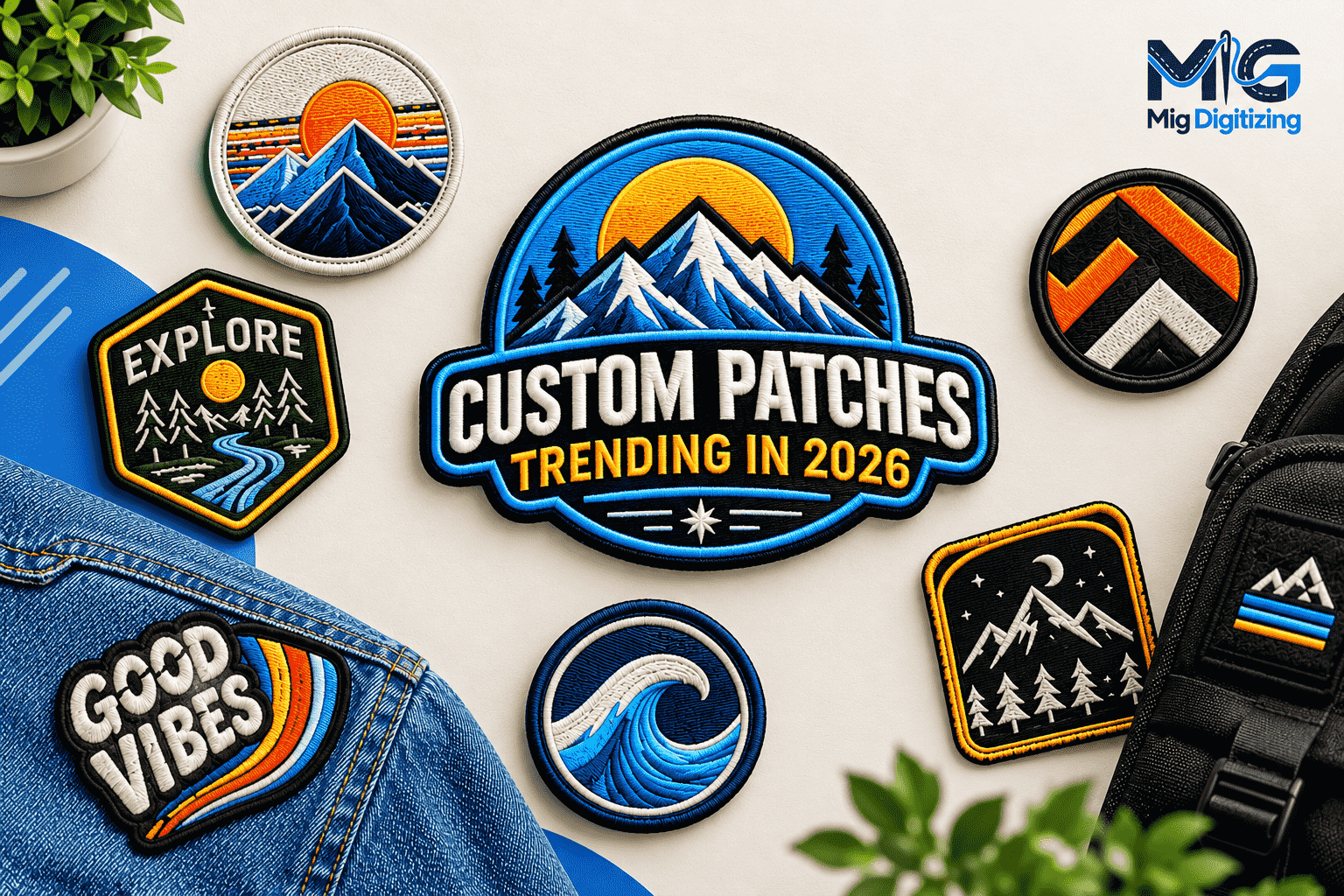
Custom patches are becoming more than just a uniform patch or a simple piece of clothing adornment. They're being employed to tell a story, build brand recognition, customize clothing, and add texture to fashion garments in 2026. Whether it's a large logo on a denim jacket or a modest logo patch on a cap, the choices are endless.
The biggest custom patch trends in 2026 aren't restricted to any particular material or visual style. Rather, the designs that are available today are a mix of nostalgia, personalization, minimalism, texture, and materials that are easy to use. Vintage graphics, raised embroidery, chenille, bold typography, nature-inspired artwork, PVC designs, and clean minimalist patches are all being utilized for various applications.
With the increasing variety, the decision on what patch to pick up is no longer just a matter of embroidered or printed. The materials used in the patch, the backing, the shape, colors, stitch density, size, and location of the patch can all affect the appearance and functioning of the completed product.
Printed graphics are not always the material texture that you can get from a custom patch. Garments can be created to be dimensional using embroidery, chenille, PVC, leather, and mixed media constructions to enhance the presence of a logo or artwork.
One of the other major reasons for their continued popularity is personalization. Whether it's a custom name patch, initials, slogan, symbol, club badges, or brand logos, people and organizations are able to design something that feels unique and not mass-produced.
Now the 2026 trend is towards minimalism, vintage style, craftsmanship with texture, and fewer saturated colors. Meanwhile, there are certain audiences that should always wear bold statement designs and tactical PVC styles.
The versatility of this type makes it applicable to various fashion, sports, business branding, outdoor clothing, uniforms, bags, and accessory applications.
Here are some of the most prominent trends in custom patch designs for 2026.
3D puff patches give 3D volume to parts of a design embroidered. Foam is positioned under the stitching to provide a raised appearance that can highlight lettering, logos, symbols, and more.
As of 2026, it's moving toward more controlled, sculpted depth instead of having everything on a patch raised quite a bit. More balanced dimensional effects and subdued colors and layouts are featured in some current trend reports.
This style is great for caps, streetwear, sportswear, and fashion branding, where the tactile logo can be a part of the visual identity.
For denim jackets, biker gear, casual streetwear, and retro styles, vintage patches are a sure bet to continue to follow.
These designs can feature faded colors, distressed artwork, old-school typography, classic badges, banners, mascots, or nostalgic illustrations. Instead of creating a flawless patch, designers can give it a worn or aged look.
Retro patch designs can also be paired with classic embroidery borders and textured stitching for a more refined and collected look.
Typography patches are about words, initials, numbers, slogans, or a short statement as the primary visual element.
If the patch is meant to be a statement, then large lettering is great. Different lettering styles, such as varsity lettering, condensed lettering, handwritten lettering, collegiate numbers, and bold block lettering, can all be used to produce various moods.
The typography may be used in a business to brand a name or as a short identifier. The same can be used to express personality, humor, attitude, or community identity for fashion and streetwear.
Minimalist patches do just the opposite. They do not use a lot of colours and complex artwork, but simple shapes, clean lines, limited colours, and recognisable symbols.
Tone-on-tone designs feature a similar shade for the patch to the garment, creating a subtle effect. For instance, a dark charcoal jacket with a black embroidered logo is able to produce branding without being too glaring.
From a current perspective, minimalist and low-saturation styles are highlighted as significant trends for 2026, especially when it comes to contemporary branding and casual wear.
The first thing that will distinguish a Chenille patch from regular flat embroidery is the softness and fuzziness of the finish on the patch. These are very connected to varsity jackets, college wear, sports teams, and retro fashion.
The texture creates a thick, chunky look for chenille patches, and large letters and numbers complement the material nicely.
The year 2026 sees chenille popping up in items beyond the confines of school jackets, with its presence in hoodies, bags, fashion, and casual garments. Indeed, the chenille and varsity patch looks make a comeback to the industry and are specifically recognised as a year-long favourite, with the patches on the industry radar screen.
A more subtle choice is floral patterns and artwork inspired by nature.
These can be popular concepts such as flowers, leaves, vines, mountains, forests, animals, celestial elements, mushrooms and illustrations of various plants. They can be embroidered in intricate patterns or abstracted to create simpler designs.
Outdoor gear, casual wear, hats, canvas bags, and denim jackets are great places to use nature-inspired patches.
The design can also be tailored to a specific flower, plant, landscape, or symbol, which makes it ideal for custom-made collections.
One of the most useful patch programs is personalization. Custom name patches can feature a person's name, nickname, job title, team number, initials, or other identifying details.
They can be used in:
Uniforms and workwear
Sportswear and bags
Children's clothes
Clubs and personal wear
Businesses can also use name patches to incorporate their branding along with employee identification. For the consumers, personalized patches offer a very simple approach to making an otherwise generic outfit seem distinctive.
Oversized patches are intended to be the main focus of a piece of clothing.
A big patch that covers the back of a denim or bomber jacket can really feel like an art piece that's put on. This is a great strategy for streetwear, motorcycle gear, bands, and special fashion collections.
When designing oversized items, it is important to be mindful of the placement of patches and construction, backing, and the weight. The patch should be sizeable enough to be noticeable, but not too large as to be impractical for the material.
Mixed-media patches are patches that include various materials or techniques in the design.
For instance, a base could be embroidered and then finished with PVC details, woven areas, leather pieces, chenille, and/or metallic thread, or other decorative accents.
This way, the designer can have more control over the texture and the hierarchy of the visual. Embroidery can be used as the main image in a logo, for a raised area to show emphasis, and for a contrasting area to set it apart.
When a regular embroidered patch would not have all the visual elements necessary for the design, mixed-media construction is helpful.
Tactical patches are still used in the outdoor, motorcycle, and workwear and equipment fields. The PVC patches are especially beneficial in places that require durability and water repellency.
Clean geometric shapes, subdued colors, symbols, short slogans, and morale-patch aesthetics are all acceptable for these patches.
The ongoing trend in 2026 is also one of tactical minimalism, with the focus on dull shades, making graphics and design as streamlined as possible, and focusing on designs that appear functional.
PVC and rubber-type patches may also be suitable for users who want to take the patch off or put it on. For users who want to remove and replace patches, PVC and rubber-style patches may also be appropriate with hook-and-loop or Velcro-type patches.
The material you select is going to have an impact on both your look and your performance. Various patch materials are appropriate for various designs.
Embroidered patches continue to be one of the most versatile choices that can be made. Thread is used to provide texture and is ideal for logos, names, badges, symbols, and decorative artwork.
They come in various colors and backing materials, which can be used in apparel, uniforms, hats, bags, and promotional items.
Thinner threads and a woven construction are used for woven patches, which can replicate certain small details and lettering in a cleaner way than with traditional embroidery.
They look flatter and smoother, and are great for detailed logos, small text, labels, and minimalist branding.
The distinctive texture of Chenille is a fuzziness that gives the surface a soft, textured feel. It is especially recommended for varsity letters, large numbers, school-like graphics, and retro fashion.
It is a different texture from normal machine embroidery and adds to the texture of the garments to make them look more interesting.
PVC and rubber patches give a smooth, long-lasting, three-dimensional look. They are especially suitable for outdoor products, tactical products, backpacks, motorcycle products, and applications where moisture resistance is needed.
They can even be very simple graphics and shapes.
Leather patches are used to give a rugged or premium look and are widely applied to denim, bags, jackets, shoes, and lifestyle products.
Depending on the material and the finishing, logos can be embossed, debossed, printed, or otherwise processed.
The color and shape are significant factors in the overall look of the patch on the garment.
Olive, khaki, brown, cream, muted green, dusty blue, and terracotta are all earthy shades that are perfect for vintage and outdoor designs.
These hues can also go with denim and neutral items without overpowering them.
Neutral shades such as black, white, gray, beige, cream, and similar shades are effective in achieving a clean and modern look.
For companies that prefer to maintain subtle branding or for fashion labels with simple visual identities, monochromatic patches are a valuable addition.
Contrast may be added to individual elements with gold, silver, or metallic threads. The metallic material can be used for borders, lettering, small symbols, or highlights instead of covering an entire patch.
This can help to create visual depth while not distracting from the artwork.
Traditional circles, rectangles, and shields are helpful too, but die-cut patches are useful in allowing the outline of the patch to follow the shape of the artwork.
Organic outlines are great for animals, flowers, characters, logos, and odd illustrations. Patch backing and garment should always be taken into consideration when dealing with shape.
Today, jackets are one of the most natural uses for patches. Large back designs, sleeve patches, chest logos, and multiple smaller patches are all acceptable.
Vintage, oversized, typography, and textural styles work well for streetwear. The styles enable patches to serve as a significant fashion statement instead of just a brand.
The curved surface of a cap reduces the embroidery area, so it's important to carefully consider it.
Simple graphics and simplified logos, initials, and short words generally work better than very detailed graphics.
Clean shapes, raised embroidery, and solid lettering that is easy to recognize at a smaller size are common features of popular hat and cap designs.
Sports and varsity apparel are of course the perfect fit for chenille, embroidered numbers and team names, mascots, and letter patches.
Large typography and traditional school-inspired designs can help to foster a team identity, while providing school players, schools and organisations with opportunities to add a personal touch to their clothing.
Patches can be attached to backpacks, tote bags, canvas bags, travel gear and accessories as well.
Depending on the product, embroidered, PVC, leather, or woven patches can all be appropriate, as bags are frequently made from durable materials.
Patches can be used to display company logos, employee names, departments, job roles, or to adorn business uniforms.
Custom patches for business branding are generally those that keep the company's logo recognizable and in line with its colors and image.
Durability and readability may be more important than keeping up with a fleeting fashion trend for workwear.
Rubber, PVC, leather, and embroidered patches are often applied to outdoor clothing and motorcycle gear.
Velcro-backed tactical patches are convenient for changing and removing designs, while sewn patches offer a longer-lasting solution.
While there's no universal style that appeals to all markets, minimalist styles, vintage and retro patches, raised embroidery, chenille textures, and personalized patches are all popular trend features in 2026. The right selection is to be made based on the garment to be created and the target audience.
Yes. Embroidered patches are still popular for women's clothing, uniforms, branding, sports, jackets, hats, and accessories. The versatility of their design, durability, customization, and texture makes them relevant for many uses.
Yes. 3D and raised puff embroidery is still popular in fashion, caps, streetwear, team merchandise, and branding. Recent trend coverage also suggests more measured, more dimensional designs and effects, instead of overly cumbersome coverage.
There are many different types of patches that can work great for streetwear, such as vintage, oversized, typography, 3D puff, minimalist, and mixed-media. It depends on the style of clothing and the brand identity. Vintage and distressed are especially popular with the contemporary retro streetwear style.
Embroidered or woven patches are often the right choice for business logos due to their ability to clearly reproduce logos and names, as well as a simple visual identity. Simple, muted designs can easily be incorporated into uniforms and branded clothing as well.
Yes. In 2026, Chenille retains its significance in the realm of varsity jackets, sporting wear, collegiate fashion, hooded sweatshirts, and retro styles. It is soft and raised, creating a type of embroidery that is different than traditional flat embroidery.
There is no single best material. Woven patches are suitable for small letters and fine details, chenille is suitable for giving a soft, raised look, PVC is suitable for weather resistance, and leather is suitable for achieving a high-quality or rustic feel. This is dependent upon the art, garment, use, durability, and look of the print.
Oct 20 , 2026 at 12:06:50
Oct 19 , 2026 at 11:12:47
Oct 21 , 2026 at 06:37:49