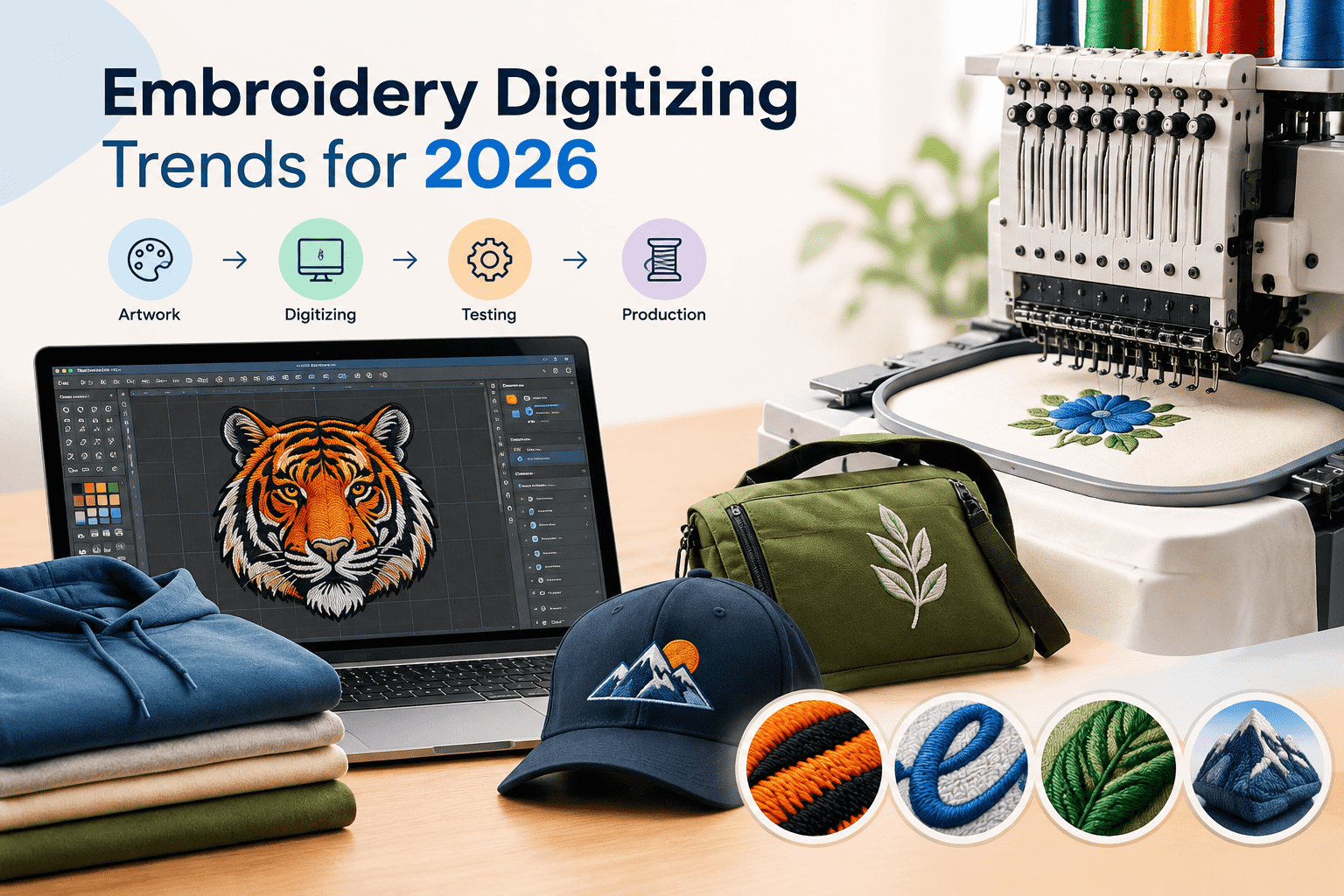
In 2026, embroidery is changing from creating stitches from artwork to more than that. The focus is now on both the efficiency with which the design can be computerized and the performance of the design on a particular fabric type and the quality of the reproduction of small detail, texture, lettering and dimensional effects.
Embroidery businesses are no longer simply seeing the latest embroidery digitizing tendencies; they are experiencing them. This also impacts stitch planning, file preparation, testing, and production efficiency, as well as how a design can be adapted for caps, hoodies, stretch fabrics, bags and more. A well-designed 2026 workflow is thus a blend of creative direction and technical control – not a one-click phenomenon of digitizing.
AI-powered digitizing is now a part of the broader design dialogue, especially when it comes to quickening repetitive tasks, brainstorming variations, streamlining artwork, and assisting designers to move from an idea to an embroidery-ready concept. While AI can help generate references, detect visual elements, or speed up various aspects of the digital process, it doesn’t obviate the technical demands of embroidery.
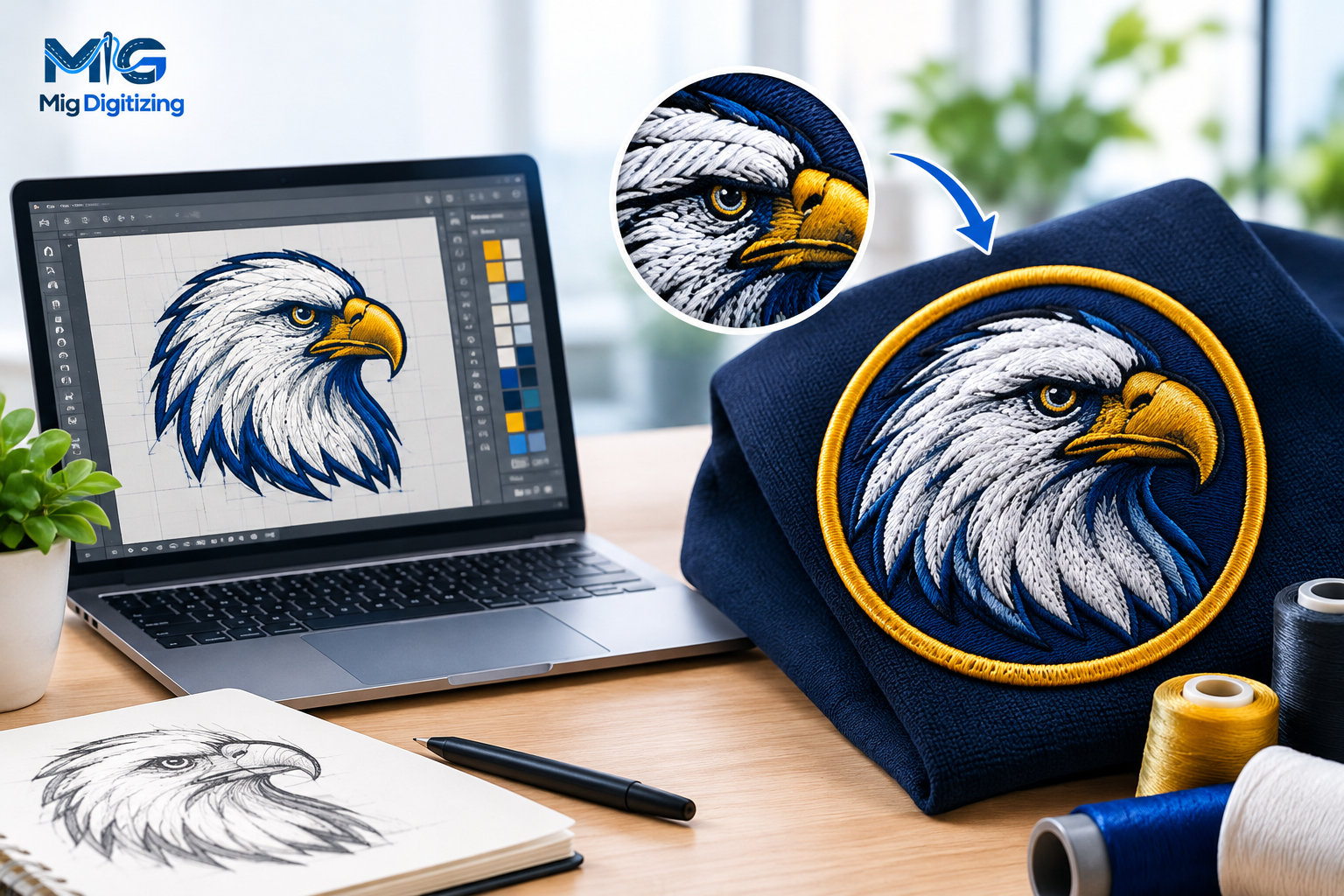
The final step of an embroidery digitizer is to determine how the artwork needs to be converted into stitches. Small lettering, overlapping areas, direction of stitching, underlay, density, pull compensation, trims, and fabric behavior are examples of areas that call for practical judgment. AI-based digitization, therefore, should be considered to support production workflows, not replace them.
As companies prefer to receive embroidery design files that show up as production-ready designs instead of the ones that look correct on a computer screen, the planning of stitches is becoming increasingly relevant. By the way, if the stitch path is well planned, there are fewer stitches to be thrown, cut, changed, and reworked, and the machine can follow the stitch, since it is designed in a logical sequence to move through the stitch.
It’s not just about cutting down on the number of stitches. The coverage can be compromised, or weak edges can be made by using too much stitch reduction. Embroidery digitizing services ensure that there is an economical stitch count, appearance, stability of the design, machine compatibility, and garment or product specifications.
3D puff embroidery for caps, streetwear, varsity-inspired designs and logos is still a big trend in 2026. The simple shapes and typography are placed in the raised effect by placing foam underneath the selected areas. Both Broken Arrow Wear and Printful share dimensional and textured embroidery as key trends for 2026.
It is best suited for artworks that are created for it. Narrow gaps or very fine details and overly complicated shapes can lose clarity when raised. The specialized digitizer tweaks stitch coverage, borders, sequencing, and shapes to ensure a clean finish after cutting and finishing, even with foam.
New techniques such as colour blending and gradient embroidery are opening up the visual potential of machine embroidery. Designers can now get softer transitions and more illustrative effects from more blended applications of different thread colors, rather than just processed blocks of one color that were clearly separated. As embroideries become more and more refined in color treatment, so do the modern embroidery techniques, although there is no guarantee of the outcome due to the variety of embroidery machines, thread systems, software and production methods.
Requires the careful planning of gradient work, as thread isn’t ink. The digital gradient can’t just be copied from stitch to stitch. The digitizer has to decide on the overlap of colors, direction of stitches and how the fabric will affect the sense of the stitch transition.
Embroidery is more textured and layered than other stitches to create a stronger tactile quality for the designs. One way to achieve this contrast without filling in with heavy stitching is by appliqué, by using several layers of fabric, adding satin borders, adding raised areas or by using a combination of surface treatments. This can be helpful in a design that requires bulk without excessive stitch volume.
Mixed-media decoration is also gaining popularity since embroidery may be used in conjunction with other modes of decoration. It is crucial to plan the entire finished design, as well as the edges of the print, appliqué and embroidery, instead of digitizing each piece individually.
On the other side of the spectrum, however, minimalist embroidery remains appropriate for brands and customers seeking subtle embellishment. These require fine line motifs, small logos, monograms and tone-on-tone designs to make it look premium without dominating the garment.
Even though it is minimalism, it does not automatically mean it will be easy to digitize. Technically challenging: small lettering and thin lines. The digitizer will need to take into consideration the minimum size and dimensions of the design, movement of the fabric, type of stitch, and stitch density, to ensure that the image is easy to read once the fabric has been stitched and washed.
The customization of clothes and accessories is closely linked to the personalization of embroidery. Businesses can create products for smaller audiences without having to go all the way to large standard runs, with the use of names, initials, signatures, niche graphics, team identifiers and small-batch collections.
This tendency makes it more important to use efficient custom embroidery digitizing. There may be multiple iterations of the same design that are needed, and each design may involve a controlled change in lettering, placement, size or color of the threads. Those variations become more easily achievable when working in a consistent digitizing workflow without compromising the quality.
Another trend for embroidery in 2026 is its retro and heritage style. Vintage lettering, folk references, old-school badges, classic sports aesthetics and nostalgic motifs are all exceptions, as the stitch treatment further emphasizes the character of the artwork.
The stitch direction, stitch texture, stitch borders, limited color palettes, and a slightly distressed visual reference are a few elements that can help achieve a period-inspired effect while still providing a clean, machine-ready stitch. The challenge is to maintain the reference-ness of the reference without adding needless stitch complexity.
Machine embroidery is an art form that is suited to bold typography and geometric graphics, which can be easily read even when cut into thread. Big lettering, badges, symbols, blocks, stripes and organized line work can help establish an instant visual effect on caps, jackets, sweatshirts, and bags.
There is still technical work for typography. Sometimes letter spacing, stroke width, direction of the letters and the relationship between the adjacent letters can make a word look crisp or cramped. The design could be simplified prior to digitization for smaller applications.
Hybrid decoration involves embroidery and other means of decoration on the surface, which are used together in order to obtain an effect which cannot be done efficiently by one technique alone. Fine imagery can be separated from tactile accents by using printed backgrounds and appliqué sections as well as embroidered outlines and raised details.
With the emergence of the mixed-media process, there is a greater need for planning. It is essential that production teams have clear artwork, exact placement, compatible materials, and a sequence; this way, one process doesn’t interfere with the other.
Sustainability is becoming an integral component of the embroidery conversation as brands look at recycled fabrics, more responsible materials, efficient production and less waste. Printful’s trend coverage emphasizes sustainable fabrics and eco-friendly production methods for 2026.
Efficiency can help achieve the overall objective of digitizing by reducing unnecessary stitch volume, trims, and rework. Label sustainability cannot be limited to just marketing – decisions on material, sampling, production volume, and waste are all significant.
Another aspect of professional digitizing is that small details are important. Although it may be impressive, embroidery machines have their limitations when it comes to micro embroidery, tiny logos, compact lettering, or delicate line art. Very fine lines and fine text may require enlarging, simplifying or changing to more appropriate stitch structures.
Depending on the design, fabric, thread, machine and production technique, the size that can actually be used is different. Hence, it is important to perform a sew-out to validate precision embroidery digitizing and not rely on a digital preview alone.
AI can help generate ideas, variations of artwork, clean up images, create images for reference, and do repetitive digital jobs. It can also be used to test out various visual lines prior to the final embroidery file being completed. These may reduce the amount of work in the early stages and provide additional options for businesses to consider.
Embroidery is a manual technique. The image that looks right on screen may be different when it’s cut out in print and put on fabric. The human digitizers know about issues like underlay, direction of stitch, pull compensation, density, thread behavior, registration, and machine limitations. They are particularly vital when there is small fine print, overlapping details or requirements for a particular fabric.
Although they are not as glamorous as clinical trials, testing and quality control are still important.
Sew-out testing is still an important aspect of the professional embroidery production process. It identifies problems like thread breaks, fabric puckering, poor registration, insufficient coverage, distorted lettering, or an inappropriate stitch path before going into a larger production run. Although AI can assist with this process, there is still a need for quality control, which requires a physical inspection of the result.
A production file for embroidery should lead the machine in a logical manner through the embroidery. Appropriate stitch sequencing can make movements less redundant and keep similar elements together. It can also be easier to use thread changes and trims during the production process.
Stitch density should be suitable for the textile and pattern. A too-low or too-high number of stitches may produce gaps or poor coverage, or excess density can add bulk and cause puckering. Some areas contract and shift during embroidery, and to compensate for this, pull compensation is used. These settings need to be customized instead of being applied the same to all designs.
The key is to get a consistent (and appealing) finish while minimizing unnecessary cuts and delays in the production process. Saving a few stitches isn’t worth it if it results in thread breaks, warped edges, or unregistering. In 2026, the emphasis is on efficiency with the right amount of stitches, not on a minimum number of stitches for any given piece.
The curved surface, center seam and small working area of caps can make the cap digitizing process quite special. Bold typography and 3D puff effects are good, but the design and stitch sequence need to take into consideration the structure of the cap.
Heavy clothing such as hoodies can support more designs and larger stitched zones, but too dense will add unnecessary weight. The thickness of the fabric and the desired hand feel should be considered with raised effects, bold typography and textured embroidery.
Stretch fabrics require closer monitoring for stabilization, underlay, density and compensation for pull. A design that works on a stable twill can end up looking like a mess on a lightweight knit. Embroidery digitization for fabric will help keep the embroidered lettering and shapes clean.
To hide small details, you can use fleece, ribbed fabrics, towels, etc. Readability can be enhanced by using larger shapes, an appropriate underlay, thicker borders and adequate density. The artwork is not a universal file, but rather should be assessed based on the actual product.
Choose your audience and product first and then pick a trend. A minimalist logo might be appropriate for a corporate outfit, and 3D puff might be more suitable for streetwear or caps. The use of the trend should reinforce the intent of the product.
Not all designs require the latest technique. Choose stitch structures, types of threads, backing, foam, appliqué materials and file settings based on artwork and fabric. This is more effective than just adding effects due to popularity.
A sample sew-out can uncover issues in advance of they grow to be costly. Review lettering, borders, density, registration, color balance and fabric action. Prior to approving for a larger run, modify the production-ready embroidery files.
The design can be more complex, with more colors, more trims, and slower production. Think about the use, washability, sale and reproduction of the final piece. The best commercial designs are those that have a visual impact that can be reproduced.
The incorporation of AI is expected to enhance embroidery digitizing software and creative processes further, but replacing professional embroidery digitizers with AI alone would involve tackling the physical factors that impact real-world embroidery. The type of fabric, hooping, machine action, tension of the thread, registration, stitch density and sew-out results can only be judged to a limited extent from artwork alone.
For 2026, the need is more towards collaboration: Technology can help with repetitive work or exploration; experienced embroidery digitizers can take care of technical decisions, fabric-specific adjustments, testing, and quality control. But automation does not replace production skills and can help businesses speed up workflows.
Key areas of focus are AI-powered workflows, smarter stitch planning, 3D puff and raised embroidery, personalization, bold typography, minimalism, mixed media decoration, sustainable use, retro – and more precise treatment of small details.
Yes. AI and automation can be used to assist in preparing artwork, developing concepts, creating variations and parts of the digitization process. Embroidery is influenced by the physical materials, machines, threads and fabrics, and human review is still a crucial element.
Yes. Bold logos, caps, streetwear and varsity designs are still a trend in 2026, and it’s here to stay. It is best suited to use when the artwork is specially prepared for raised stitching.
Smarter stitch planning involves organizing stitch paths, sequencing, stitch density, underlay, and trims for the design to be produced in an efficient manner that still covers, registers, reads and finishes clean.
Embroidery effects on various fabrics vary. Registration and appearance may vary with stretch, thickness, texture and stability, so a file that works on one material may need to be altered for another.
Yes. There is a general trend toward subtle textured styles and minimalist line work, small logos, monograms, and tone-on-tone treatments in the 2026 realm of customization.
While AI can streamline or speed up certain steps, there are still aspects of the process that require human expertise, such as physical testing, fabric selection, stitching, machine compatibility, and quality control. A rep. man still has an important role to play in terms of production reliability.
Oct 14 , 2026 at 11:29:42
Oct 13 , 2026 at 08:17:47
Oct 14 , 2026 at 04:41:53